October 3, 2026
Life in Naxos: What Tourists Usually Miss
Most people meet Naxos between June and September, somewhere between a sunbed and a sunset. Fair enough. But the island you see in August is the island on its busiest shift. The real one clocks in before you wake up, goes quiet exactly when you head to the beach, and does its best partying in February, in the fog, wearing a hundred kilos of sheep bells.
This guide is about real Naxos. Not the sights, but life in Naxos. How the day actually runs, and what the island looks like when the ferries thin out. Think of it as the stuff locals know and never think to tell you.
What is life in Naxos really like?
Life in Naxos runs on a farmer’s clock, not a holiday one. Around 20,000 people live here all year, and most of their days revolve around olive trees, goats, potatoes and each other.
Naxos is a working island. The 2021 census counted 19,812 permanent residents in the Municipality of Naxos and the Small Cyclades, about 900 more than ten years earlier. A little under half of them live in and around Chora. The rest are scattered across dozens of villages, each with its own saint, its own accent and a very strong opinion about whose cheese is best.
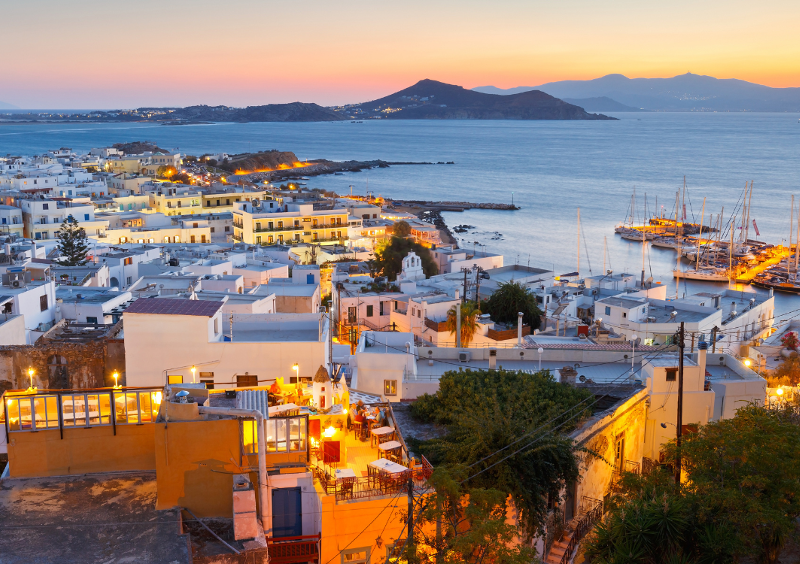
And when summer ends, the island doesn’t switch off. The beach bars close, but Chora keeps its bakeries, pharmacies and tavernas going, and the ferries keep coming all year round. The biggest party on the calendar isn’t even in August. It’s carnival, in February or March, when grown men strap on sheep bells and the mountain villages shake.
Our advice: If a village looks closed at 4pm, it isn’t. It’s napping. Come back after 6, when the chairs come out of the kafeneio and everyone is in the mood to talk.
The Naxian day has its own clock
Locals start early, stop in the heat, and come back to life in the evening. Once you know the pattern, the island suddenly makes sense.
- Early morning: Farmers and shepherds are already out. In the villages, the first coffee is poured while it’s still cool, and the delivery vans do their rounds.
- Late morning: Errands, bank, pharmacy, a quick chat that somehow lasts forty minutes. This is when Chora feels most like a real town.
- Mesimeri (early afternoon): Lunch, then rest. In Greece this isn’t just a habit, it’s written down. From April to September, 15:00 to 17:30 is the official quiet time, and loud music or building work is not allowed. From 1 October it shifts to 15:30–17:30.
- Evening: Shops reopen, squares fill, kids take over the streets, and grandparents take over the benches.
- Night: Dinner at 21:00 is normal. Nobody will look at you strangely at 22:30.
Our advice: Plan your village visits for the morning or after 18:00. Knock on a door at 16:00 and you’ll learn the Greek word for “really?” very quickly.
Life in Chora is different than life in villages
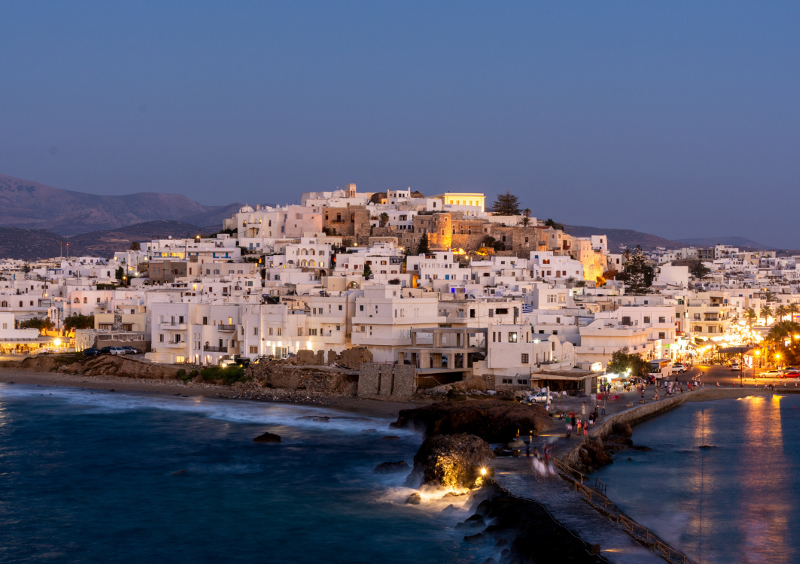
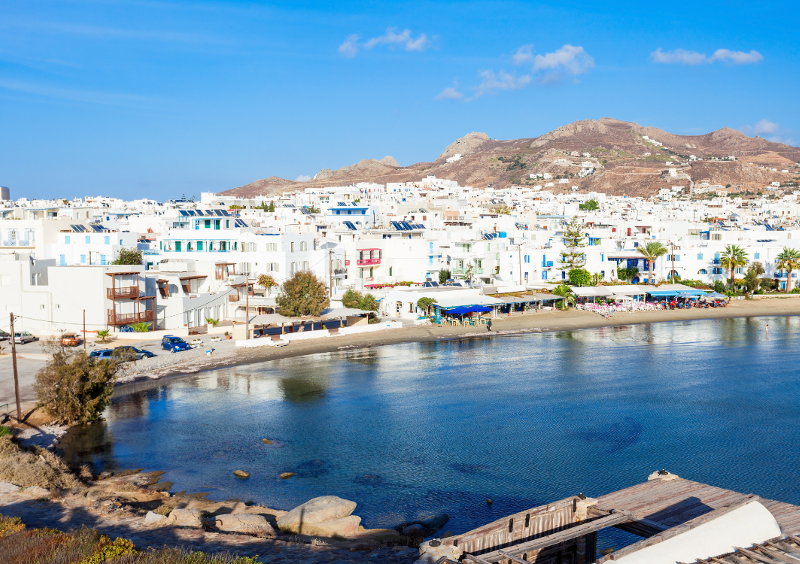
Chora is the island’s small capital. The villages are where its identity lives. Locals even split the island in two, the flatter, farming villages around the plains (often called Katochoria or Livadochoria, the “lower” or “meadow” villages) and the mountain villages up towards Mount Zas.
The difference is not just altitude. Historically, mountain villages like Kinidaros, Apeiranthos, Komiaki and Koronos produced most of the island’s musicians, who would then travel down to play at weddings and feasts in the lowland villages. Each place has its own carnival costume, its own saint’s day and, often, its own way of speaking.
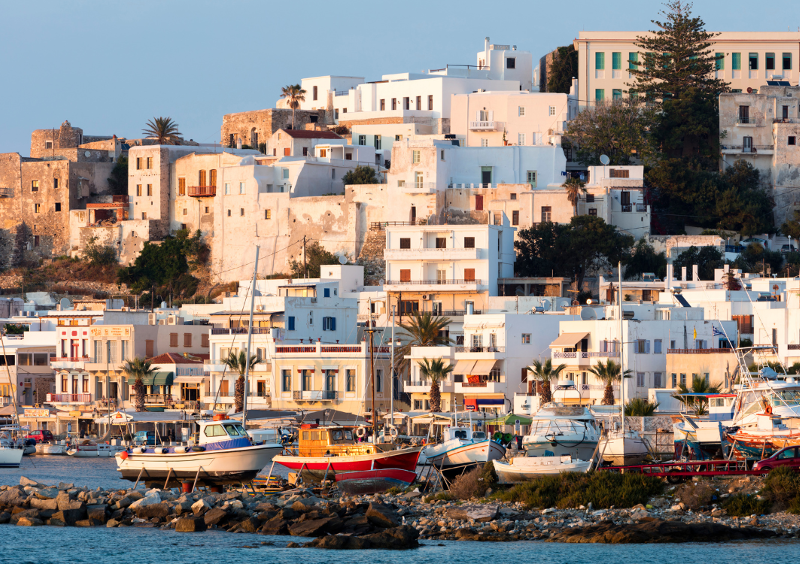
In Chora, life looks like any Greek island town. School runs, cafés, the harbour, the Saturday coffee that turns into lunch. Drive (or ride) twenty minutes inland and you’re somewhere that measures time by milking, harvests and church bells.
The village kafeneio is the island’s living room
If you want to see daily life in Naxos, sit in a village kafeneio for an hour. It’s the traditional coffee house, and in small villages it’s also the meeting point, the news desk and sometimes the grocery shop. A few things to know to get deep into the Naxian culture:
- Say hello when you arrive: A simple kaliméra (good morning) or yia sas (hello) to the room goes a long way.
- Order a Greek coffee: Ask for it métrio if you want it medium sweet. It’s served with a glass of water.
- Don’t rush: Nobody will bring you the bill until you ask for it. That’s not bad service, that’s the point.
- Accept the treat: If someone at the next table pays for your coffee or sends over a shot of kitron, just say efcharistó (thank you) and raise your glass.
You’ll notice board games like tavli (backgammon), lots of arguing that isn’t really arguing, and conversations about rain, prices, animals and who’s getting married. That, right there, is life in Naxos.
Naxian people love local music
On Naxos, the soundtrack of a celebration is almost always a violin and a laouto (a Greek lute). Locals call the pair a takimi, and across the islands this kind of band is simply called ta violia, “the violins”, as opposed to the clarinet bands of mainland Greece.
This matters because the music isn’t a show put on for visitors. The players come from the villages themselves, and several of the island’s best-known musical families have kept the tradition going for generations. Older traditions survive too: the tsambouna, a goatskin bagpipe, still comes out at carnival time and at small gatherings in people’s homes.
If you’re on the island during a village feast, you’ll hear it live. If you’re not, ask in a taverna whether any violia are playing that week. Somebody always knows.
Naxos throws its wildest party in winter
The biggest local celebration most tourists never see is carnival (Apokries), in the weeks before Orthodox Lent. It’s cold, it’s often foggy up in the mountains, and it’s absolutely nothing like a summer beach party.
Each part of the island does it differently:
- The Koudounatoi of Apeiranthos come out on the last Sunday of carnival. Men and boys wear the abadeli, a heavy woollen shepherd’s cape, handmade shepherd’s shoes, and around fifteen bells tied round the waist on a thick rope. They charge into the small square, and even into the shops, jumping to make the bells roar. For people in Apeiranthos this isn’t a fancy dress. Ιt’s a matter of honour.
- The Koudounatoi of Filoti appear on Tsiknopempti (the Thursday of meat week) and on Clean Monday. Filoti is the shepherds’ village, where people say every farmer recognises his own animals’ bells from kilometres away. Here the costume is simpler, but the bells are many more. Locals talk of up to 120 bells, with a full load that can top 100 kilos, which is why you’ll see some of them lying flat on their backs in the street, catching their breath.
- The Kordelatoi rule the lower villages instead, dressed in bright, colourful ribbons, alongside the Foustanelades in traditional kilts.
- In Chora, the Saturday night brings the Lampadiforia, a torch-lit procession, and on Sunday the Dionysian Carnival parade takes over the seafront with floats and satire.
The dates move with Orthodox Easter. In 2027, Clean Monday falls on 15 March, so the big carnival weekend is 13–15 March.
Our advice: Dress warm, stand back when the bells start moving, and don’t be surprised if someone hands you a glass of wine mid-parade.
Winter is when Naxos becomes Naxos again
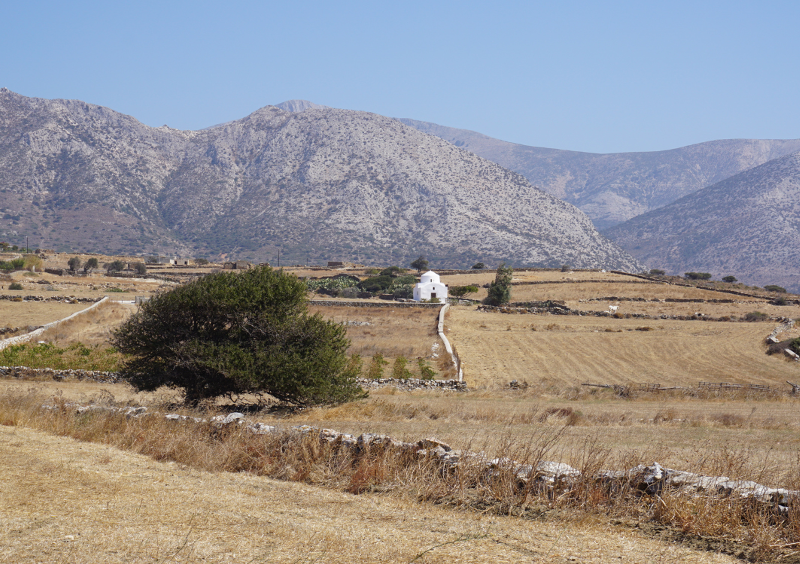
From November to March, Naxos goes back to being a farming island with a capital town. Beach hotels and bars close, but around 20,000 people still live here, go to school, run businesses and head to church on Sundays.
What changes when the season ends:
- Ferries run all year, just less often, and the Meltemi gives way to winter storms that can occasionally cancel sailings.
- Rain finally arrives. Almost all of the island’s rain falls between October and March, and the hills turn green fast.
- Autumn is harvest time. Grapes, then olives, then the first winter cheeses.
- Chora stays open. Bakeries, pharmacies, the hospital and the tavernas locals actually eat keep going.
It’s not a beach holiday. But if you want to see life in Naxos without the summer filter, late autumn and early spring are a gift to really experience the indigenous rhythm of Naxos.
How to live like a local in Naxos, even for a few days
You don’t need to move here to taste real life in Naxos. You just need to change your timing and slow your pace.
- Start one day in a village, not on a beach. Coffee in Filoti or Halki at 9am tells you more than any museum.
- Respect the afternoon. Rest when the island rests, go out when it wakes up.
- Eat where the locals eat. If the menu is only in Greek and the TV is showing the news, you’ve found it.
- Ask about the saint’s day. Almost every village has one. If it falls during your stay, go.
- Learn five words. Kaliméra, yia sas, efcharistó, parakaló, stin iyiá mas (cheers). People notice.
- Leave the car for a day. Villages were built for feet and animals, not SUVs. For a straight comparison, read Rent a Bike vs Rent a Car in Naxos.
- Come back off-season. Carnival, the olive harvest or a quiet spring week will show you a completely different island.
See local life with an e-bike
The places where life in Naxos really happens are 15 to 30 kilometres inland, up roads that climb. That’s exactly where a car turns into a problem. Narrow village lanes, no parking, and a windscreen between you and everything worth noticing.
An e-bike fixes that. The motor takes the sting out of the hills, so you can roll into a village square quietly, lean the bike against a wall and actually stay a while. You hear the bells of a flock before you see it. You smell the thyme. You stop when someone waves. And you leave nothing behind but tyre tracks.
If you’d rather have a local open the doors for you, our guided e-bike tours are built around this side of the island. Get in touch to book a bike or a tour, and spend a day living on the island rather than just visiting it.
Planning the rest of your trip? Take a look at How to Spend a Day in Naxos, Greece and 9 Top Reasons to Visit Naxos.
Frequently asked questions about life in Naxos
What is it like to live in Naxos?
Life in Naxos follows a farming and village rhythm rather than a tourist one. Around 20,000 people live here year-round. Days start early, the afternoon is quiet by law (15:00–17:30 in summer), and social life happens in the evening, in squares and kafeneia.
Do people live in Naxos all year?
Yes. The Municipality of Naxos and the Small Cyclades recorded 19,812 permanent residents in the 2021 census, and its population has been growing. Chora stays open all winter, with shops, schools, a hospital and ferries to Piraeus.
When is the carnival in Naxos?
Carnival runs in the weeks before Orthodox Lent, so the date changes each year. In 2027, Clean Monday is 15 March. Look for the Koudounatoi in Apeiranthos on the last Sunday of carnival, and in Filoti on Tsiknopempti and Clean Monday.
Is Naxos worth visiting in winter?
If you want local life rather than beaches, yes. Most beach hotels close from November to March, but Chora stays active, the countryside turns green, and you’ll meet far more locals than tourists.