Αύγουστος 4, 2026
The Indigenous Rhythm of Naxos: Food, Culture, and What Most Tourists Miss
Here’s a thing that happens on Naxos. You spend three days on the beach, decide on day four to drive inland “just to see,” and by the time you’re winding through olive groves at 400 metres with a goat standing in the road looking at you, you realise you’ve been on the wrong island all week. Not the wrong island exactly. Just the outside of it.
Because here’s what daily life on Naxos actually looks like. Τhis is the biggest and greenest island in the Cyclades, with about 20,500 people living on it year-round and roughly 150,000 sheep and goats wandering around above them. It runs on a farming calendar, not a tourist one. Cheese gets made in winter. Liqueur gets distilled from leaves picked in January. Villages throw enormous all-night parties on saints’ days from Easter until December, and nobody puts them on a poster.
That’s the rhythm this guide is about. What people here really eat, when things really happen, and the handful of places that will make your trip feel like it belonged to you rather than to a package.
What is the truth about Naxian beaches?
Most visitors land, drive eight kilometres down the west coast, and settle somewhere between Agios Prokopios, Agia Anna and Plaka for the week. Those beaches are genuinely world-class and you should absolutely go.
But that strip is maybe 5% of Naxos. Turn inland and the island stops performing. Villages turn from tourist attractions to working places with milk collection points, olive presses, cheese cellars and old mine tunnels, and they carry on exactly the same whether you show up or not. That’s precisely why going there feels so good.
Our advice: Go to the beach in the afternoon, and in the mountains in the morning. Everything interesting inland happens before 2pm anyway.
The island’s calendar and its agriculture
Ask a shepherd in Filoti when “the season” is and they won’t say August. Milk comes with the winter rain, which is why Naxos’ big aged cheeses are winter cheeses. Arseniko (the sharp, oily-rubbed sheep and goat cheese that’s the island’s cult product) is made roughly November to April and then left to sit for at least three months. Xinomizithra (the soft tangy one), is the summer cheese. Order that crumbled over your salad instead of feta and watch the waiter’s face change.
The citron trees run on their own clock. The leaves used to make kitron, Naxos’ liqueur, get picked between October and February. So the ice-cold shot someone pours you in July was made in the dead of winter.
Potatoes get two goes at it, spring and autumn. And yes, that’s worth mentioning, because Naxos has been Greece’s official seed-potato island since 1950. It’s the unglamorous reason a plate of fried potatoes here tastes like something.
So, depending on the month of your visit, you get to see:
| If you come in… | This is what the island is doing |
| May–June | Spring potato harvest, everything still green, feast season opening. Quietly the best month. |
| July–August | Panigiria almost every week. Hot, busy, and the most fun. |
| September–October | Olive harvest starts, sea still warm, roads empty. The insider’s month. |
| November–April | Milk season. Cheese being made, citron leaves distilled, almost no visitors. |
What to actually eat (and what to order by name)
Naxos gets called the food bowl of the Cyclades so often it sounds like marketing. It isn’t. The island’s farming cooperative has been going since 1926, collects milk from around 500 farmers, and turns it into cheese within about eight hours of leaving the animal. Tankers run twice a day for exactly that reason.
The star is Graviera Naxou, a PDO cheese made here since 1996, and currently sitting at number one on TasteAtlas‘ list of the best-rated cheeses in the world, scoring 4.6 out of 5.
Some traditional dishes you should definitely try if you visit Naxos include:
- Patatato: Goat slow-cooked with Naxian potatoes. If you get to eat only one thing during your stay, this must be it.
- Rosto: pork braised in a pot with an unreasonable but correct amount of garlic.
- Kalogeros: beef, aubergine and melted local cheese. Rich, old-fashioned, brilliant.
- Sefoukloti: Chard pie. A fasting dish that villages never stopped making.
- Patoudo: Lamb stuffed with wild fennel and celery. Easter only.
- Zamboni: Cured pork leg, the island’s charcuterie.
- Kitron: The digestif. Locals prefer the white 33°. Ask for white and you’ll get a nod.
One small tip that changes everything: Before you order fried cheese, ask for a plate of local cheeses. Graviera, aged arseniko, a spoon of thyme honey. That’s the island on a plate for about the price of a cocktail.
Villages you must visit
Halki: a village with a distillery in the middle of it
Halki was the island’s commercial capital long before Chora took over. Marble streets, neoclassical shutters, a couple of very good little shops, and old men who’ve been having the same argument since 1970 are what you will see as soon as you step foot on the village.
Then walk two minutes to Panagia Protothronos, one of the two most important Byzantine churches in the Cyclades, standing casually at the end of the street like it’s nothing.
Time it right: Halki in the morning, coffee in the square, church, then lunch. That’s a perfect half-day.
The Tragea: an olive forest with 6th-century churches hidden in it (H3)
Below Mount Zas spreads the Tragea valley, a huge, ancient olive grove that people call a “Byzantine park,” and for once the nickname is earned. Under the trees sit early basilicas from the 6th and 7th centuries and a scatter of little 11th-to-13th-century chapels, linked by stone paths, old watermills and oak groves.
The one to find is Panagia Drosiani, just outside the village of Moni. Parts of its frescoes date to the 6th century and are among the oldest surviving in the Balkans. It’s tiny, low, made of bare stone, open daily, free to walk into, and there is usually nobody else there.
Fourteen centuries of people have painted, repainted and prayed in that one small room. There’s a village cemetery outside. You’ll stay longer than you planned.
The road nobody drives: Naxos’ emery country
Naxos holds essentially all of Greece’s workable emery, a brutally hard rock (7–9 on the Mohs scale) that was the best abrasive in the world before synthetics came along. Locals call it “smirigli”. It’s still legally a state monopoly: miners hand everything they dig to the Greek state, which sells it, around 8,000 tonnes a year.
In the 1940s roughly 3,000 people worked these mines. Today it’s a few hundred. What’s left is one of the most quietly cinematic things on the island: rusting aerial ropeway pylons striding over empty ridges, sealed tunnel mouths, stone loading stations going back to the hillside. Almost no visitor goes looking for them.
How to see it: Take the road between Koronos and Apeiranthos and just look up at the ridgelines. And if you get talking to an older man in a Koronos kafeneio, ask about the mines. You will not get a short answer. You shouldn’t want one.
Panigiria: the best night out you can have in Naxos
A panigiri is a village saint’s-day feast. Church service first, then long tables in the square, violin and lute, food and wine, and dancing until the sky goes grey. These are not shows. Nobody is being paid to be charming. They’re the most alive thing that happens on this island, and outsiders are genuinely, warmly welcome.
Dates worth planning around your trip, so that you can visit a panigiri:
- First Friday after Easter: Panagia Argokiliotissa, Koronos. The island’s biggest panigiri. Many people walk the entire way.
- 14 July: Agios Nikodimos, Chora and Glinado. The patron saint of Naxos.
- 17 July: Agia Marina, Koronos and Agidia.
- 6 August: Sotiros, in Glinado, Damarionas and Kourounochori.
- 15 August: Panagia. Island-wide, and enormous in Filoti.
- 29 August: Agios Ioannis, Apeiranthos and Apollonas.
- 8 September: Panagia Drosiani at Moni, Theoskepasti at Komiaki.
Three unwritten rules: eat whatever lands in front of you, don’t film the dancing for the first hour, and if someone fills your glass, let them. Arrive around 9–10pm. Don’t plan anything for the next morning.
The layer that isn’t in the guidebooks: Catholic Naxos
Naxos was the capital of a Venetian duchy from 1207, and unlike most of the Aegean it kept its Catholic community afterwards. The Kastro in Chora is still Catholic ground, which means when you walk up there through the white arrows, you’re crossing between two versions of Greece in about ninety seconds.
Inside it stands the Ursuline School, founded in 1628 and later the first school for girls ever to operate in Greece. Its commercial academy was famous enough nationally that a teenage Nikos Kazantzakis was sent here from Crete in 1897. He later called the Eggares valley in the north of the island “an earthly paradise”, a verdict you’ll agree with if you ride through it in spring.
A perfect Naxos day, start to finish
If you want one, flawless day in Naxos that gives you all of the above:
- 08:30: Leave Chora early, head inland before the heat.
- 09:30: Coffee in Halki, then the Vallindras distillery and Panagia Protothronos.
- 11:00: Ten minutes on to Panagia Drosiani near Moni. Ten quiet minutes inside.
- 12:00: Climb to Apeiranthos. Wander the marble alleys, then a long lunch.
- 15:00: Drop down the Koronos road, ropeway pylons on the ridge above you.
- 17:30: Back down to the west coast for a swim and the sunset you came for.
That’s roughly 60km round trip on beautiful, quiet roads.
How to travel at the island’s speed
Everything above sits between 15 and 35 kilometres from Chora, on roads that climb. A car will get you there, but it also seals you off from the exact thing you came for. The smell of an olive grove at nine in the morning. A farmer flagging you down. The moment the whole Tragea opens up below you on the bend after Sangri.
This is where an e-bike genuinely changes the trip. The motor flattens the climbs, so you spend your energy looking around instead of suffering. You stop wherever you want, park anywhere, and get to farms, chapels and viewpoints no coach can reach. It’s also the quietest way to arrive somewhere, which matters more than it sounds when you’re rolling into a village square at siesta time.
If you’d rather have someone local open the doors for you, our guided e-bike tours are built around exactly this side of Naxos:
- One rides through Melanes and Eggares, Kazantzakis’ “earthly paradise”, past the ancient marble Kouros lying in his field, to a stone-mill olive press and a working farm. Around 4 hours.
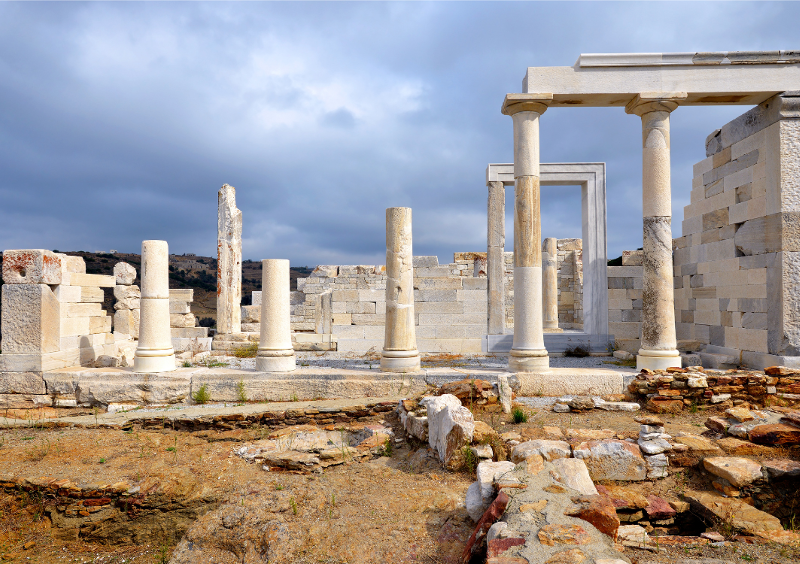
- The other heads to Sangri and the Temple of Demeter, then to a shepherd’s farm where you make cheese with milk from the animals standing in front of you, and eat lunch built from what that farm grew. Around 5 hours.
Both include a local guide, headsets, water, fruit, tastings and entry fees, and both end early enough for the beach.
Planning the rest of your trip? Have a look at our guides to the top things to do in Naxos and the best reasons to visit the island.
Explore the other side of Naxos
The island doesn’t hide its real life. It just keeps it eight kilometres inland, where the road starts climbing and the buses stop going.
Head up there in the morning, eat what the valley grew, and let a village decide how long you stay.
Get in touch with Aurelia Bikes to book an e-bike or a guided tour, and see the Naxos most people drive straight past.
Frequently asked questions
What food is Naxos famous for?
Graviera Naxou, a PDO cheese currently ranked the world’s best on Taste Atlas, plus sharp arseniko and soft xinomizithra cheeses, PGI-protected Naxian potatoes, thyme honey, and kitron, a liqueur distilled from citron tree leaves. Order patatato, rosto or kalogeros in a village taverna.
When is the best time to visit Naxos for local life?
Late May, June, September and early October. The countryside is green, the sea is warm, the roads are quiet, and villages are getting on with their year rather than hosting a crowd.
Is Naxos good for cycling?
Yes. There’s a big network of rural roads and trails connecting villages, farms and beaches. The interior is mountainous, so an e-bike is the practical choice if you want to reach Halki, Filoti or Apeiranthos comfortably in a single day.
Can visitors go to a Greek village festival?
Absolutely. A panigiri is a community feast, not a performance, and visitors are welcome. Turn up around 9–10pm, eat what you’re given, buy a round, and join the dancing when the circle opens up.
How many days do you need in Naxos?
Five to seven. Two or three for the beaches, at least two for the mountain villages and the Tragea valley, and one spare for whichever place you end up not wanting to leave.